
DeSoto County Historical Society
PAST • PRESENT • FUTURE
ARCADIA, FLORIDA
The DeSoto County Historical Society, Inc. is a not-for-profit 501(c)3 corporation dedicated to preserving and promoting the history of DeSoto County, Florida for future generations.
BECOME A MEMBER
As a member you will receive a monthly newsletter inviting you to our programs and events, our monthly meetings, Pioneer Day festival on the fourth Saturday in March, and more. Click Here for Membership Application
DeSoto County Historical Society Upcoming Events
Also shown are other noteworthy events in DeSoto County
6th Annual Florida Cracker Meal
Date & Time: Saturday, Oct. 3rd, 5:30pm – 7:30pm
Location: Pine Level Church, Fellowship Hall, 9695 NW Pine Level St.
Tickets: $20 ea. Limited Seating. Get our tickets early! Tickets are available from the Society, Radio Shack and Crews Bank & Trust, Member FDIC, 2747 SE Highway 70
Menu: Traditional Florida Cracker Foods: Pork Steaks, Rice and Tomato Gravy, Black Eyed Peas, Sweet Potatoes, Collard Greens, Cornmeal Muffins, Fresh Churned Butter, Peanut Butter Pie, Other Delicious Desserts.


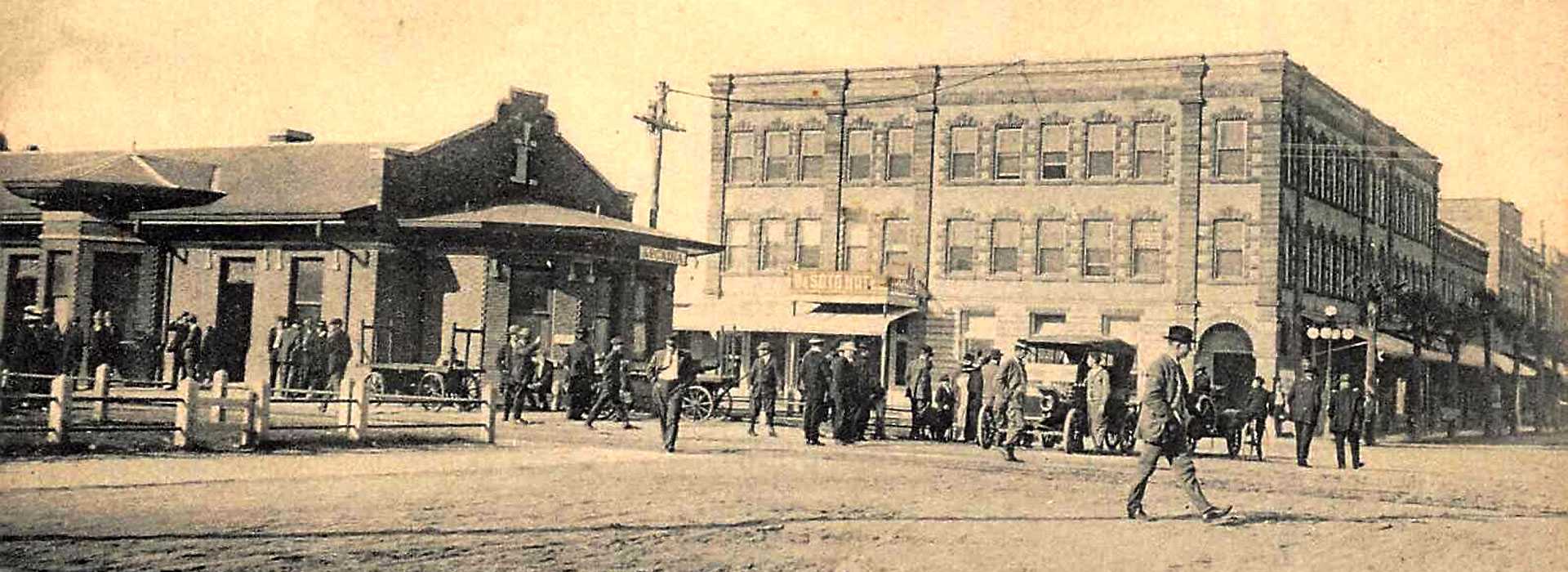
The History of Arcadia
Long-leaf pines, also known as yellow pines, grew thickly on the east shore of Peace River. In 1883, James Madison “Boss” Hendry, a Baptist preacher, moved his sawmill here by ox-drawn wagon. Along the way, he stayed overnight in the home of Thomas H. Albritton, a fellow Baptist at Lily. Hendry told the family that his birthday was the following day, so Mrs. Albritton and her daughter Arcadia baked a cake for him. In appreciation for their kindness, Hendry promised to honor Arcadia by naming for her the town he predicted would arise. In 1883, a post office called Arcadia was established at the settlement near Hendry’s sawmill.
In 1881, Captain Francis J. LeBaron of the U.S. Army Corps of Engineers surveyed Peace River and found pebble phosphate in the riverbed. Six years later, his associate T. S. Morehead established the first company to “mine” phosphate from the river. At first, the mineral was extracted with pick and shovel, but later steam-driven dredges were used. By 1908, mining of the river ceased, and companies began strip-mining deposits of phosphate in Polk County.
The first train of the Florida Southern Railway arrived in Arcadia on March 4, 1886. Arcadia was the “end of the line” for several months, and during that time, its population increased so much that it was able to incorporate as a town in December. Fifteen years later, in 1901, Arcadia reincorporated as a city.